TL;DR
If your air conditioner is less than 10 years old and needs a relatively minor repair, fixing it is often the most cost-effective decision. However, if your system is more than 15 years old, requires frequent repairs, struggles to cool your home, or has experienced a major component failure, replacing it may save you money and frustration over the long term.
The best decision isn’t based on age alone. It’s about understanding the condition of your system, the type of repair needed, and your long-term goals as a homeowner.
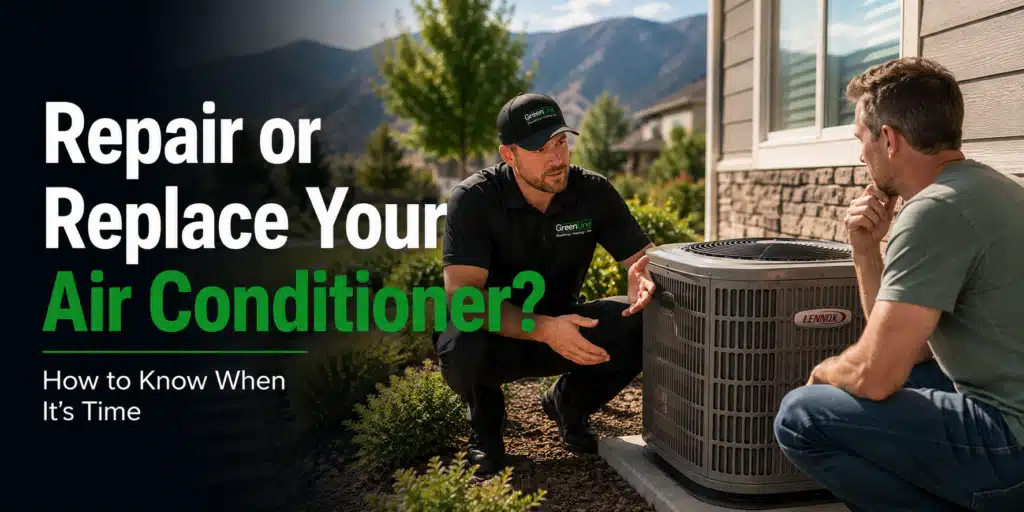
Repair or Replace Your Air Conditioner? Here’s How to Make the Right Decision
It usually happens during the hottest week of the summer.
Your air conditioner has finally stopped keeping up with the heat, and after a technician diagnoses the problem, you’re faced with a question every homeowner hopes to avoid.
“Should I repair it, or is it finally time to replace it?”
It’s a question without a one-size-fits-all answer.
Some homeowners immediately assume they need a new system because their air conditioner is getting older. Others continue repairing the same unit year after year because they want to avoid the cost of replacement.
In reality, neither approach is always the right one.
We’ve repaired systems that continued running reliably for many years after a simple fix. We’ve also inspected older units where replacing the equipment was clearly the better financial decision because another major repair was likely just around the corner.
The key isn’t choosing the cheapest option today. It’s choosing the option that provides the best value over the next five to ten years.
Start With the Problem, Not the Age
One of the biggest misconceptions in the HVAC industry is that age alone determines whether an air conditioner should be replaced.
While the age of the equipment is certainly important, it’s only one piece of the puzzle.
A well-maintained 12-year-old system may still have several reliable years ahead of it. Meanwhile, an eight-year-old unit that has experienced multiple refrigerant leaks, electrical failures, or poor maintenance may already be approaching the point where replacement becomes the smarter investment.
That’s why every recommendation should begin with a thorough inspection of the system rather than a discussion about its birthday.
Before deciding on replacement, we first identify exactly what’s wrong, how extensive the repair will be, and whether the issue is likely to lead to additional problems in the near future.
If your air conditioner has recently stopped cooling altogether, our Air Conditioning Repair service begins with a complete diagnostic so you understand the actual cause of the problem before making any major decisions.
How Long Should an Air Conditioner Last?
Most modern central air conditioning systems are designed to last somewhere between 12 and 18 years, depending on several factors.
That estimate assumes the system has been properly maintained throughout its life. Annual tune-ups, clean air filters, and timely repairs all play a significant role in extending equipment lifespan.
According to the U.S. Department of Energy, routine maintenance helps HVAC systems operate more efficiently while reducing unnecessary wear on critical components.
Utah’s climate also plays a role.
Although our dry climate is easier on equipment than humid coastal environments, long periods of triple-digit temperatures mean air conditioners often work extremely hard during the summer months. Extended run times naturally place more stress on compressors, capacitors, motors, and other moving parts.
Age should be viewed as context rather than a deciding factor.
When Repairing Your AC Makes Sense
In many situations, repairing your air conditioner is absolutely the right decision.
If the system has otherwise been reliable and the repair is relatively straightforward, restoring it to full operation is often far more economical than replacing the entire unit.
We commonly recommend repairs when the system is still in good overall condition and the issue involves components such as a capacitor, contactor, thermostat, blower motor, or other parts that can be replaced without significantly affecting the long-term reliability of the equipment.
We’ve also seen many homeowners assume they needed a new air conditioner because their home wasn’t cooling properly, only to discover the problem was something much simpler like a clogged condenser coil, restricted airflow, or a failing electrical component.
These repairs typically restore performance without requiring the expense of a full system replacement.
When the repair is reasonable and the equipment still has many productive years ahead of it, repairing the system often provides the best overall value.
Sometimes the Most Expensive Repair Is the One You Keep Paying For
There comes a point when repeatedly repairing an aging air conditioner becomes more expensive than replacing it.
This doesn’t happen because a single repair is unusually costly.
It happens because small repairs begin stacking on top of each other.
One summer it’s a capacitor.
The next year it’s a blower motor.
Then a refrigerant leak develops.
A few months later the compressor begins struggling.
Individually, each repair may seem manageable. Collectively, they become a pattern.
When we evaluate older systems, we’re not just looking at today’s repair. We’re looking at the likelihood of future repairs, declining efficiency, parts availability, and how well the equipment is still meeting your home’s cooling needs.
Sometimes investing in another repair simply delays a much larger decision that will need to be made in the near future anyway.
The “50% Rule” Isn’t Always the Right Rule
You may have heard about the “50% Rule.”
It suggests that if a repair costs more than half the price of a new air conditioner, replacement is the better investment.
While this can be a helpful guideline, it shouldn’t be treated as an absolute rule.
Imagine two different homeowners.
The first has an eight-year-old air conditioner that has been exceptionally reliable. The compressor unexpectedly fails, but the rest of the system is in excellent condition. Even if the repair is significant, replacing the compressor may allow the system to provide many more years of dependable service.
The second homeowner has a sixteen-year-old system that’s needed multiple repairs over the past few summers. This year it’s a refrigerant leak, last year it needed a blower motor, and the year before it required electrical work. Even if the current repair isn’t especially expensive, those repeated costs begin adding up.
The better question isn’t simply, “How much does this repair cost?”
It’s, “How likely am I to face another major repair in the next few years?”
That’s the conversation we believe homeowners deserve.
Signs It May Be Time to Replace Your Air Conditioner
Air conditioners rarely fail all at once. More often, they gradually become less reliable, less efficient, and less capable of keeping your home comfortable.
If you’ve started noticing several of these warning signs together, replacement may be worth considering.
Your home never seems to cool evenly anymore. Certain bedrooms stay noticeably warmer than the rest of the house, even though the system runs almost continuously.
Utility bills continue climbing despite using your thermostat the same way you always have. As equipment ages, efficiency naturally declines, causing longer run times and higher operating costs.
Repairs become more frequent. Maybe each repair isn’t particularly expensive on its own, but you’re calling for service every summer instead of every few years.
Your system still uses R-410A? Great. If it uses older refrigerants that are becoming harder to source, future repairs can become increasingly expensive. (For newer regulations, homeowners should also be aware that refrigerant standards continue to evolve, making efficiency and long-term serviceability important considerations.)
Finally, there’s comfort itself.
If your family spends every summer wondering whether the AC will make it through another heat wave, the peace of mind that comes with a dependable new system is worth considering alongside the financial aspects.
The Hidden Cost of Keeping an Older Air Conditioner
Most homeowners compare the cost of a repair to the cost of a new system.
What often gets overlooked is everything in between.
An aging air conditioner usually doesn’t fail in dramatic fashion overnight. Instead, it slowly becomes less efficient year after year.
That means:
- Longer cooling cycles.
- Higher monthly utility bills.
- More wear on electrical components.
- Less consistent temperatures throughout the home.
- Increased likelihood of emergency repairs during the hottest days of summer.
According to ENERGY STAR, replacing older equipment with a properly sized, high-efficiency system can significantly reduce cooling costs for many homeowners while improving indoor comfort.
Those monthly savings won’t completely pay for a new air conditioner overnight, but over the life of the equipment they become an important part of the overall investment.
What We Tell Our Customers
One thing we’ve learned after helping homeowners throughout Salt Lake County and northern Utah County is that every house—and every homeowner—is different.
Some people plan to stay in their home for another twenty years.
Others may be moving within the next few years.
Some homeowners value the lowest possible upfront investment.
Others prioritize reliability, quieter operation, improved indoor comfort, or lower monthly utility costs.
Those priorities matter just as much as the repair itself.
Our goal isn’t to convince you to replace your system.
Our goal is to give you enough information to confidently choose the option that makes the most sense for your situation.
Sometimes that’s a repair.
Sometimes it’s replacement.
Both can be the right answer depending on the circumstances.
Should You Replace Your Air Conditioner Before It Breaks?
This is becoming a more common question than it used to be.
Many homeowners don’t want to wait until the hottest day of the year to make an important decision under pressure.
Planning ahead has several advantages.
You have time to compare equipment options, explore financing if needed, schedule installation at a convenient time, and avoid the stress of losing cooling during extreme summer temperatures.
On the other hand, replacing equipment too early can also mean giving up years of useful service from a system that’s still performing well.
That’s why we rarely recommend replacement based solely on age.
Instead, we evaluate how the system is performing today and what it’s likely to look like over the next several years.
If replacement does make sense, our Air Conditioning Installation team can help you compare high-efficiency options that are properly sized for your home and designed to provide reliable comfort for years to come.
Don’t Forget About Maintenance
Whether you choose to repair your current system or invest in a new one, ongoing maintenance is one of the best ways to protect that investment.
Annual inspections allow technicians to identify worn electrical components, clean condenser coils, verify refrigerant performance, and catch small issues before they become expensive repairs.
We’ve seen well-maintained systems last several years longer than neglected equipment simply because problems were addressed early.
Our HVAC Maintenance Plan is designed to help homeowners stay ahead of unexpected breakdowns while improving efficiency and extending the life of their heating and cooling equipment.
Frequently Asked Questions
Is it worth repairing a 15-year-old air conditioner?
It depends on the condition of the system and the repair that’s needed. If the unit has been reliable and the repair is relatively minor, it may still make sense to repair it. If the system has experienced multiple recent issues or requires a major component replacement, investing in a new air conditioner may provide better long-term value.
Should I replace my AC if the compressor fails?
Not always.
A compressor replacement can be a smart investment on newer systems that are otherwise in good condition. On older equipment, replacing the entire system is often the more practical long-term solution. A professional inspection can help determine which option makes the most financial sense.
How long should a central air conditioner last?
Most systems last between 12 and 18 years with proper maintenance. Factors such as usage, maintenance history, installation quality, and climate all influence overall lifespan.
Will a new air conditioner lower my electric bill?
Many homeowners notice lower energy consumption after replacing older, inefficient equipment with a modern high-efficiency system. The exact savings depend on the age of the previous system, your home’s insulation, thermostat settings, and overall cooling habits.
Should I wait until my air conditioner completely stops working?
No. If your system is already struggling, requiring frequent repairs, or becoming unreliable, planning for replacement before a complete breakdown often gives you more options and reduces the likelihood of an emergency replacement during the hottest part of the summer.
What we recommend
One of the biggest misconceptions we encounter is that every older air conditioner should automatically be replaced.
That’s simply not true.
We’ve repaired older systems that continued operating reliably for years afterward, and we’ve also recommended replacement for newer systems that had experienced extensive damage or recurring problems.
Every recommendation starts with understanding the condition of your equipment, not its age alone.
When we inspect an air conditioner, our goal is to give you honest information, explain the pros and cons of each option, and let you make the decision that’s best for your home and your budget.
No pressure. Just straightforward guidance from people who genuinely want to help.
Final Thoughts
Deciding whether to repair or replace your air conditioner isn’t always easy, but it doesn’t have to be confusing.
A thorough inspection, an honest evaluation, and a clear understanding of your options can help you make a decision with confidence rather than uncertainty.
If your AC has been struggling to keep up, requiring frequent repairs, or you’re simply wondering whether it’s time to start planning for a replacement, Green Line Plumbing, Heating & Air is here to help.
We’ll evaluate your system, answer your questions, and provide recommendations based on what’s best for your home—not a one-size-fits-all sales pitch.