Yes, although the reason is a little different than it is with an older furnace.
When equipment is relatively new, you’re obviously less concerned about age-related deterioration. But new equipment still accumulates operating hours, moves air through filters and coils, relies on electrical and mechanical components, and needs to operate within the conditions it was designed for.
Maintenance also gives us an opportunity to identify installation or airflow conditions that may not have been obvious when the equipment was originally installed.
Maybe the furnace itself is perfectly healthy, but the filter is too restrictive.
Maybe airflow isn’t balanced particularly well.
Maybe a homeowner has noticed one bedroom is consistently colder but assumed that’s just how the house is.
Those observations can be valuable even when the furnace doesn’t need a repair.
There’s also the equipment warranty to consider. Warranty and maintenance requirements vary by manufacturer and model, so homeowners should review the terms associated with their particular system. Keeping records of professional maintenance can also provide a useful service history if a warranty question comes up later.
With a newer furnace, maintenance is less about expecting something to be wrong and more about helping the system stay that way.
What About an Older Furnace?
This is where fall maintenance becomes particularly valuable.
An older furnace isn’t automatically an unsafe or unreliable furnace.
We’ve seen plenty of well-maintained heating systems continue operating effectively long after homeowners expected to replace them.
Age does, however, change the conversation.
As equipment accumulates years of operation, components have accumulated more wear. The probability of needing repairs generally increases, and the financial decision surrounding those repairs becomes more important.
Consider two furnaces with the same failing component.
One is four years old.
The other is 18 years old and has already needed several repairs.
The immediate mechanical problem might be identical, but the larger recommendation may be different.
With the newer system, repairing the component is usually an easy decision.
With the older furnace, we may want to consider the repair cost alongside its overall condition, recent repair history, comfort, efficiency, and whether other major components are also deteriorating.
A fall inspection gives you a chance to have that conversation before you’re making decisions without heat.
Furnace Maintenance vs. Furnace Repair: What’s the Difference?
These two services sometimes get lumped together, but they’re solving different problems.
Furnace maintenance is preventive.
You’re asking:
“Is my heating system ready for winter, and is there anything developing that I should know about?”
Furnace repair is corrective.
You’re asking:
“Something isn’t working correctly. What’s wrong, and how do we fix it?”
If your furnace won’t start, repeatedly shuts down, isn’t producing enough heat, makes a new mechanical noise, or has another obvious malfunction, you probably don’t need a tune-up.
You need a diagnosis.
A maintenance appointment shouldn’t be used as a substitute for troubleshooting an active furnace problem.
Likewise, you shouldn’t wait for something to break before ever having the system inspected.
The two services complement each other, but they aren’t interchangeable.
Can a Furnace Tune-Up Find Safety Problems?
This is one of the more important reasons to take heating maintenance seriously.
Gas furnaces don’t just move warm air. They involve fuel, combustion, ignition, exhaust, electrical components, and safety controls.
All of those systems need to operate correctly.
A professional furnace inspection can evaluate accessible components and system operation for conditions that may require further attention.
That doesn’t mean a tune-up provides some absolute guarantee that a safety issue can never occur afterward. No legitimate HVAC company should make that promise.
It means you’re giving a trained technician an opportunity to evaluate the equipment before months of heavy operation.
And there is one safety device we’d recommend regardless of how recently your furnace was serviced.
Carbon monoxide alarms.
Every Home With Fuel-Burning Equipment Should Take Carbon Monoxide Seriously
Carbon monoxide is particularly dangerous because you can’t see or smell it.
The U.S. Environmental Protection Agency’s carbon monoxide guidance recommends carbon monoxide alarms as an important additional safeguard against potential CO exposure. The CDC’s carbon monoxide guidance also emphasizes that CO is odorless and colorless and can cause sudden illness or death.
If your home uses a gas furnace, fireplace, gas water heater, or other fuel-burning equipment, working carbon monoxide alarms are an important layer of protection.
Test them according to the manufacturer’s instructions and replace alarms when they reach the end of their specified service life.
A furnace inspection and a carbon monoxide alarm serve different purposes.
You should have both.
If a CO alarm activates, don’t treat it as an HVAC troubleshooting exercise. Move to fresh air and follow emergency guidance rather than searching around the furnace trying to determine what’s wrong.
Does a Furnace Tune-Up Include a New Filter?
That depends on the company, service package, and type of filter your system uses.
More importantly, homeowners shouldn’t think of the filter as something that only gets addressed during annual maintenance.
Your furnace and air conditioner share the same airflow system in many homes, which means the filter has already been working throughout cooling season.
By September, it may have accumulated months of dust and debris.
Check it.
Some filters need relatively frequent replacement, while larger media filters can often operate much longer. Pets, remodeling projects, dust levels, system runtime, filter size, and filter type can all affect how quickly one becomes loaded.
Rather than relying on a universal “replace it every X days” rule, inspect the filter regularly and follow the recommendations appropriate for your particular system and filter.
What If My Furnace Hasn’t Been Serviced in Several Years?
You haven’t necessarily ruined it.
Don’t avoid scheduling maintenance because you’re worried a technician is going to lecture you about missing previous tune-ups.
What matters is the condition of the furnace now.
If it’s been several years since anyone professionally inspected the heating equipment, fall is a good opportunity to establish a baseline.
How is the system operating?
What condition are the components in?
Is airflow reasonable?
Are there any obvious concerns?
Does anything need attention now?
Is there anything worth monitoring?
Those answers are more useful than worrying about maintenance you didn’t do three years ago.
When Does Furnace Maintenance Turn Into a Repair?
Sometimes we begin a maintenance visit and discover something that requires additional work.
That doesn’t mean the tune-up “failed.”
It means it did what preventive maintenance is supposed to do.
For example, suppose a technician identifies a component that’s no longer operating within an acceptable range.
The furnace may still technically produce heat.
But now there’s a specific condition that can be discussed with the homeowner.
The technician should explain what was found, why it matters, what the options are, and whether the problem requires immediate attention or can reasonably be monitored.
From there, the homeowner can make an informed decision.
That’s much different from replacing parts simply because they’re old.
When Does Furnace Maintenance Become a Replacement Conversation?
A tune-up shouldn’t automatically become a sales appointment.
There’s an important distinction between identifying an aging furnace and telling someone they need to replace equipment simply because it’s old.
Age is one factor.
We also want to understand:
- How reliably has the furnace been operating?
- Has it required repeated repairs?
- Are major components deteriorating?
- Does the home stay comfortable?
- Are heating costs becoming difficult to justify?
- Are there significant safety or operational concerns?
- What would the current repair cost relative to the furnace’s overall condition?
- Does the homeowner plan to remain in the house?
- Would newer equipment provide meaningful benefits for this particular home?
Sometimes the answer is:
Keep the furnace.
Sometimes it’s:
Make the repair and reevaluate in a few years.
And sometimes an older furnace has reached a point where investing additional money into it doesn’t make much sense.
That’s when discussing furnace replacement becomes appropriate.
The important thing is that the recommendation should follow the inspection, not precede it.
Should You Replace a Furnace Before It Breaks?
Not necessarily.
There’s no rule saying a furnace needs to be replaced the moment it reaches a particular birthday.
At the same time, waiting until complete failure isn’t always the best strategy either.
There is a middle ground.
If you have an aging furnace that continues operating reliably and doesn’t have significant problems, continuing to use it may be perfectly reasonable.
But if maintenance reveals increasing component deterioration, recurring repairs, declining comfort, or other concerns, planning for replacement can give you significantly more control over the process.
You can research equipment.
You can evaluate options.
You can budget.
You can schedule installation at a convenient time.
That’s very different from choosing a furnace because it’s 9 p.m., your house is getting colder, and you need heat immediately.
Preventive maintenance gives you information.
What you do with that information depends on the furnace and your priorities.
How Much Does a Furnace Tune-Up Cost at Green Line?
We want homeowners to know the cost before scheduling rather than treating furnace maintenance like a mystery.
Green Line Plumbing, Heating & Air currently offers:
Standard Furnace Tune-Up: $89
Executive Furnace Tune-Up: $119
The right option depends on what level of service and inspection you’re looking for.
More importantly, our goal isn’t to use a low-cost tune-up as an excuse to tell every homeowner they need a new furnace.
We want to inspect the system, explain what we find, and help you understand whether anything actually requires attention.
If the furnace looks good, we’ll tell you.
If something needs repair, we’ll explain why.
And if the equipment is reaching a point where replacement deserves consideration, we’ll help you compare the options without forcing you into a decision.
When Should Utah Homeowners Schedule Furnace Maintenance?
If you’re reading this in September, now is an excellent time.
You don’t need to wait until the forecast shows freezing temperatures.
In fact, that’s exactly what we’re trying to avoid.
September and early October give homeowners a useful window between peak cooling season and sustained heating season.
You can have the furnace inspected, deal with any issues that are discovered, and then move into colder weather with a better understanding of the system’s condition.
If you miss that window, maintenance later in the fall is still worthwhile.
And if it’s already winter?
You haven’t “missed” maintenance entirely.
The best time is before heating season.
The second-best time is when you realize it hasn’t been done.
How Can You Prepare Your Furnace for Winter Yourself?
Professional maintenance doesn’t mean there is nothing homeowners can do.
A few simple habits can make a meaningful difference.
Check the filter periodically and replace it when needed. Keep supply registers and return vents unobstructed. Make sure the thermostat is operating correctly. Test your smoke and carbon monoxide alarms according to their manufacturers’ instructions. Keep combustible storage away from the furnace and mechanical equipment.
Then pay attention to the system.
Your furnace communicates through changes in behavior.
Maybe it starts cycling more frequently.
Maybe one room stops heating as well.
Maybe you hear a new sound.
Maybe you notice a persistent smell.
Maybe the furnace takes multiple attempts to start.
Those observations can help a technician tremendously.
You don’t need to diagnose the problem yourself.
You just need to notice when something changes.
Frequently Asked Questions About Furnace Tune-Ups
Should I get my furnace tuned up every year?
Annual professional furnace maintenance is a sensible schedule for most residential heating systems. It provides an opportunity to inspect equipment, evaluate operation, identify developing problems, and prepare the system before heavy winter use. You should also check your furnace manufacturer’s maintenance recommendations.
What month is best for a furnace tune-up in Utah?
September and October are excellent times because they fall before sustained winter heating demand. However, maintenance can still be valuable later in the heating season if you didn’t schedule it during fall.
Is a furnace tune-up necessary if my furnace is working?
That’s actually an ideal time to perform preventive maintenance. The purpose isn’t necessarily to repair something that’s already broken. It’s to inspect the system and identify developing concerns before they become larger problems.
Can a furnace tune-up prevent every breakdown?
No. Maintenance can identify many developing problems and help equipment operate properly, but no inspection can guarantee that a mechanical or electrical component won’t fail later.
How long does a furnace tune-up take?
The exact time depends on the furnace, its condition, accessibility, and what is discovered during the inspection. A thorough maintenance visit shouldn’t be rushed simply to meet an arbitrary time limit.
Will a furnace tune-up make my furnace more efficient?
Maintenance can correct certain conditions that reduce system performance, such as airflow restrictions or dirty equipment. However, it can’t change the furnace’s original efficiency rating or overcome major issues with the home itself, such as poor insulation.
Is furnace maintenance worth it on an older furnace?
It can be especially valuable. An inspection provides information about the condition of aging components and can help homeowners plan for repairs or eventual replacement before a complete heating failure occurs.
What happens if the technician finds something wrong?
A technician should explain the problem, why it matters, and what your options are before additional repair work is performed. Finding a developing problem is one of the primary reasons preventive maintenance can be valuable.
From the Green Line Team
We don’t think homeowners should be scared into scheduling furnace maintenance.
Your furnace isn’t guaranteed to break because you skipped a tune-up last year, and a tune-up isn’t a magical guarantee that nothing will ever fail.
The value is much simpler.
You get information before you need the equipment the most.
When we inspect a furnace in September, we’d much rather tell a homeowner that everything looks good than find a major problem.
And when we do find something, we’d rather explain it while the house is comfortable and the homeowner has time to consider the options.
That’s what preventive HVAC service should accomplish.
No unnecessary panic.
No replacing equipment just because it has some years on it.
Inspect the system, understand its condition, address what actually needs attention, and prepare it for the season ahead.
That’s how Green Line Plumbing, Heating & Air approaches furnace maintenance.
Get Your Furnace Ready Before Utah Gets Cold
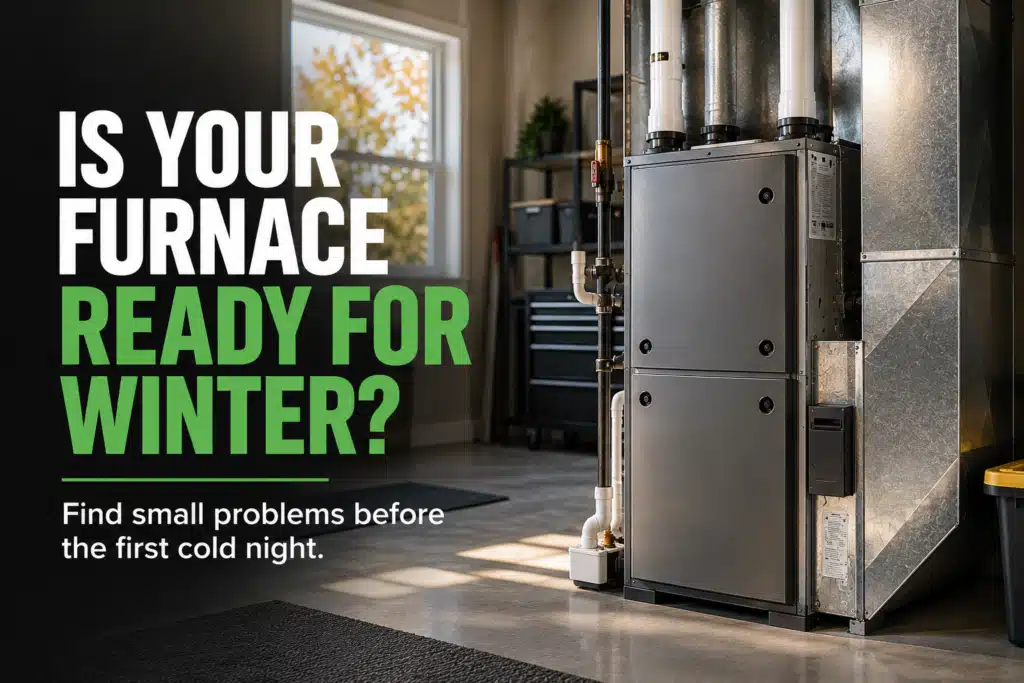
We’re still getting warm afternoons in Utah, which makes it easy to forget that heating season is right around the corner.
But that’s exactly why now is a good time to think about your furnace.
Once overnight temperatures begin falling consistently, your heating system goes from sitting idle to operating every day. If there’s a developing problem, that’s often when you’re going to discover it.
A fall furnace tune-up gives you the opportunity to find those issues earlier.
Maybe your furnace needs nothing more than routine maintenance.
Maybe there’s a small repair worth addressing.
Maybe an aging system deserves a conversation about what the next few years look like.
Whatever the answer is, it’s better to know before the first truly cold night.
Green Line Plumbing, Heating & Air provides professional furnace maintenance throughout our Utah service area, with standard furnace tune-ups starting at $89 and our Executive tune-up at $119.
To schedule your furnace tune-up before winter:
Green Line Plumbing, Heating & Air
801-252-5362
Your Local Experts That Care